
Stiffness in the first hour after waking is one of the most commonly reported everyday complaints, and it has a mundane explanation. During several hours of stillness, the fluid inside your joints has not been circulated and the soft tissue around them has settled into whatever shape you slept in. Movement is what changes that.
What follows is five movements that take about five minutes together. None of them requires equipment, floor space beyond a mat's worth, or any particular level of fitness. The point is not to be a workout. The point is to take each major joint through its range once, deliberately, before the day asks you to do it by accident.
Consistency matters far more than intensity here. Five minutes most mornings will do more than twenty minutes once a week.
Before you start
- Nothing here should hurt. Mild stretch is expected; sharp or pinching sensation is a signal to stop.
- Move slowly. None of this is improved by speed or by force.
- If you have an injury, a diagnosed joint condition, or you are recovering from surgery, ask a physiotherapist or doctor which movements suit you before following a generic routine.
- Skip anything that does not feel right for your body. There is no obligation to complete a sequence.
Cat and cow
SpineOn the floor

How
- Start on hands and knees. Hands under the shoulders, knees under the hips.
- Breathe out and round your back towards the ceiling, letting your head drop.
- Breathe in and reverse it — chest forward, tailbone up, belly towards the floor.
- Move between the two positions slowly. Eight to ten cycles.
Why it is in the list
The spine is not one joint but a stack of around twenty-four, and each has a small amount of movement available. This sequence asks all of them to flex and extend in turn, which is difficult to achieve with any single static position.
Shoulder rolls
ShouldersStanding

How
- Stand with your arms relaxed at your sides.
- Lift both shoulders towards your ears, then draw them back, then down.
- Make the circle as large as you comfortably can without forcing it.
- Ten backwards. Then five forwards, which usually feels less natural.
Why it is in the list
The shoulder has the largest range of motion of any joint in the body, and most people use a small fraction of it in daily life. Rolling backwards also counteracts the forward-rounded position that sleeping and desk work both encourage.
Standing side bend
TrunkStanding
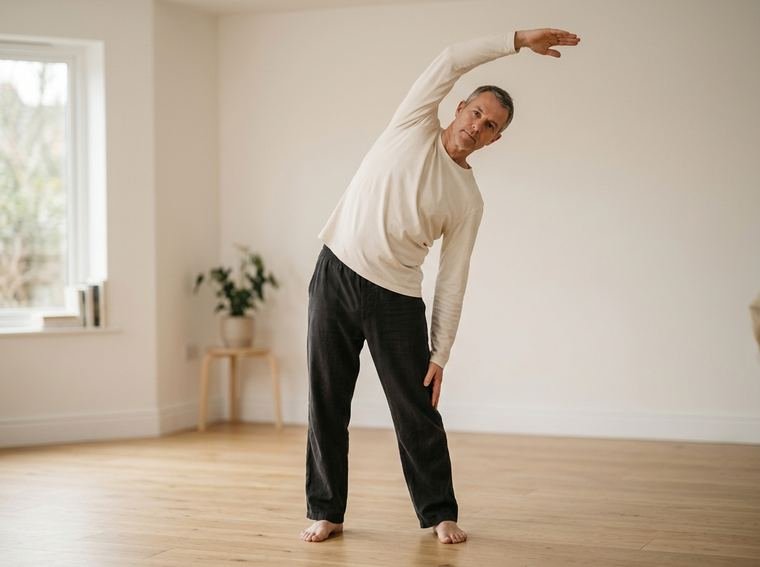
How
- Stand with feet about hip-width apart.
- Reach one arm overhead and lean towards the opposite side.
- Keep both feet flat and avoid twisting — the movement is sideways, not forwards.
- Hold for two or three slow breaths, then change sides. Twice each way.
Why it is in the list
Side bending is the direction of spinal movement people use least. Forward bending happens constantly through daily life; lateral flexion almost never happens unless it is done on purpose.
Standing knee lift
HipsStanding

How
- Stand near a wall or chair and rest a hand on it if balance is uncertain.
- Lift one knee towards your chest, as high as it goes without effort.
- Lower it slowly rather than dropping it.
- Eight on each side, alternating.
Why it is in the list
This takes the hip through flexion, which is its primary direction of movement, and it asks the standing leg to hold a position under load. Balance is trainable and it declines when it is not asked for.
Ankle circles
AnklesSeated

How
- Sit on a chair and extend one leg out in front of you.
- Draw a slow circle with your foot, moving from the ankle rather than the knee.
- Ten in one direction, ten in the other.
- Change legs.
Why it is in the list
The ankle carries the whole body every time you take a step, and it is almost never mobilised deliberately. It also happens to be a joint where restricted movement shows up further along the chain, at the knee and hip.
Putting it together
Run them in the order above and the sequence works from the middle of the body outwards, finishing at the feet, which is convenient if you do the last one sitting on the edge of the bed. There is no requirement to keep that order, and there is no requirement to do all five.
If you have ten minutes rather than five, the better use of the extra time is a second slow pass through the same movements rather than adding new ones. Familiarity is what allows you to notice change from one week to the next.
What to expect, honestly
A short mobility routine is not going to transform anything on its own, and anyone promising that it will is overselling. What it reliably does is take your joints through their available range before the day begins, which is a modest thing done consistently rather than a dramatic thing done once.
People who keep this kind of routine usually report that mornings feel less stiff within a couple of weeks. That is a subjective observation rather than a measured outcome, and it is worth stating plainly rather than dressing up as something more.