Most of the joints people think about — knees, hips, shoulders, knuckles — belong to a single family called synovial joints. They are the ones built for movement, and they share a common design that is worth understanding on its own terms, before any question of what can go right or wrong with them.
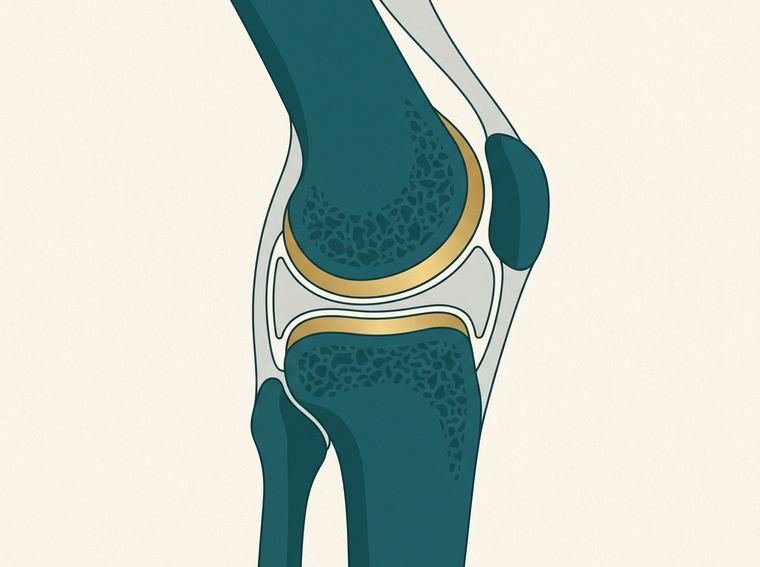
The surfaces
Where two bones meet, neither surface is bare bone. Each is capped with articular cartilage, a smooth white tissue a few millimetres thick. Cartilage has no blood supply of its own and no nerves running through it, which is why it is often described as a rather unusual tissue: it is alive, but it is fed indirectly.
The surface it presents is remarkably slippery. Comparisons to ice or oiled metal understate it — the coefficient of friction between two healthy cartilage surfaces is lower than either.
The fluid
Sealed inside the joint is a small quantity of synovial fluid. In a healthy adult knee that amount is measured in millilitres, not much more than a teaspoon. It is thick, clear and slightly yellow, and it does at least two jobs.
- It lubricates, sitting between the cartilage surfaces as they slide across one another.
- It carries nutrients. Because cartilage has no blood vessels, the fluid is how nourishment reaches the cells inside it and how waste leaves.
That second point explains something people notice without knowing why. Cartilage is loaded and unloaded as a joint moves, and that cycle helps drive fluid exchange. A joint that is not being moved is not being fed in the same way.
The capsule
Around the whole arrangement sits the joint capsule: a fibrous sleeve joining one bone to the other and enclosing the space between. Its inner lining, the synovial membrane, is what produces the fluid.
The capsule is also where much of the sensation comes from. Cartilage itself has no nerve supply, so it cannot register anything directly. The capsule, the surrounding ligaments and the bone beneath the cartilage are richly supplied with nerve endings, and they are the structures that report on what a joint is doing.
Everything around it
A joint does not work alone. Ligaments run between the bones and limit how far the joint can travel. Tendons connect muscle to bone and transmit the force that produces movement. Small fluid-filled sacs called bursae sit at points where tissues would otherwise rub. Some joints, the knee among them, contain additional cartilage structures — the menisci — that spread load across a wider area.
Together this makes a joint less like a hinge and more like an assembly, where several tissues with different properties are arranged to work as one thing.
Why the design is interesting
An engineered bearing wears down from the moment it is first used and cannot repair itself. Living tissue can, to a degree — cartilage cells maintain the matrix around them throughout life. That maintenance is slow, and it becomes slower with age, which is part of why joints are studied so closely. But the fact that the repair happens at all is what separates a biological joint from anything manufactured.