
The problem with sitting is not sitting. It is duration. A joint held in one position for three hours is not being circulated, and the muscles holding that position are doing sustained low-level work with no opportunity to release. The fix is not a better chair. It is interruption.
What follows is three movements chosen because they can be done at a desk, in normal clothes, without attracting attention, in under sixty seconds.
Before you start
- Nothing here should hurt. Mild stretch is expected; sharp or pinching sensation is a signal to stop.
- Move slowly. None of this is improved by speed or by force.
- If you have an injury, a diagnosed joint condition, or you are recovering from surgery, ask a physiotherapist or doctor which movements suit you before following a generic routine.
- Skip anything that does not feel right for your body. There is no obligation to complete a sequence.
Chin tuck and chest lift
NeckAt the desk

How
- Sit up so your weight is over your sitting bones rather than behind them.
- Draw your chin straight back, as though making a double chin. Do not tip your head down.
- At the same time, lift your breastbone slightly.
- Hold for five seconds. Repeat five times.
Why it is in the list
The head weighs roughly the same as a bowling ball, and the further forward it sits, the more work the muscles at the back of the neck do to hold it. Screens tend to draw the head forwards over time without anyone noticing.
Seated rotation
SpineAt the desk
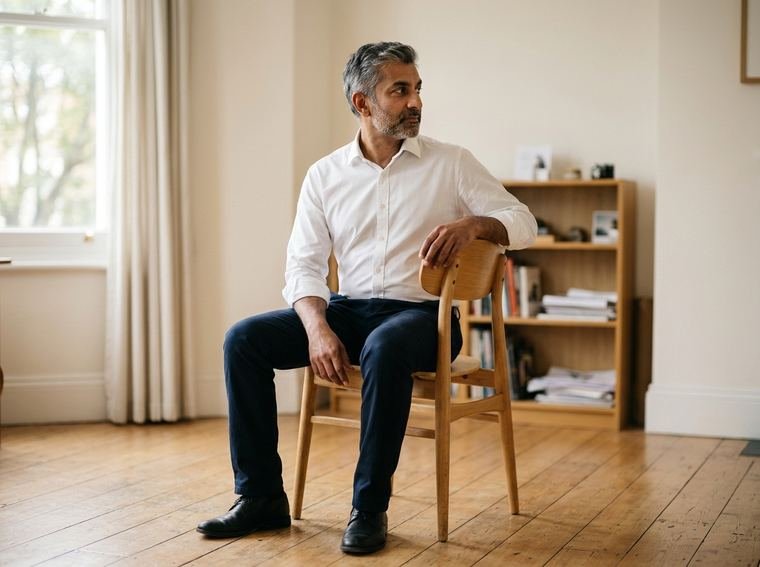
How
- Sit with both feet flat on the floor.
- Turn your upper body to one side, letting your head follow.
- You can hold the back of the chair, but use it to steady yourself rather than to pull further.
- Three slow breaths. Change sides. Twice each way.
Why it is in the list
Rotation is the second direction, after side bending, that disappears almost entirely from a sedentary day. The spine is built for it and rarely asked.
Stand and hinge
HipsStanding

How
- Stand up. Feet about hip-width apart, slight bend in the knees.
- Push your hips backwards and let your torso tip forwards, keeping the back flat.
- Go only as far as you can while keeping the back flat — for most people that is not very far.
- Return to standing. Six repetitions.
Why it is in the list
Hours of sitting keep the hips in flexion continuously. This asks them to move in the other direction, and it involves standing up, which is half the benefit on its own.
How often
The honest answer is that no specific interval has strong evidence behind it. The figures you see quoted — every thirty minutes, every hour — are sensible estimates rather than findings. What is reasonably well supported is that breaking up long sedentary periods is better than not breaking them up.
A practical approach is to attach the break to something that already happens: the end of a call, refilling a glass, waiting for something to load. Habits that depend on remembering usually lose to habits that depend on a cue.
The part nobody wants to hear
A minute of movement does not offset several hours of stillness, and it is not meant to. These breaks make the working day more comfortable and interrupt long static periods. They are not a replacement for walking, and they are not exercise. Anything presented as a desk routine that replaces exercise is being sold to you.